
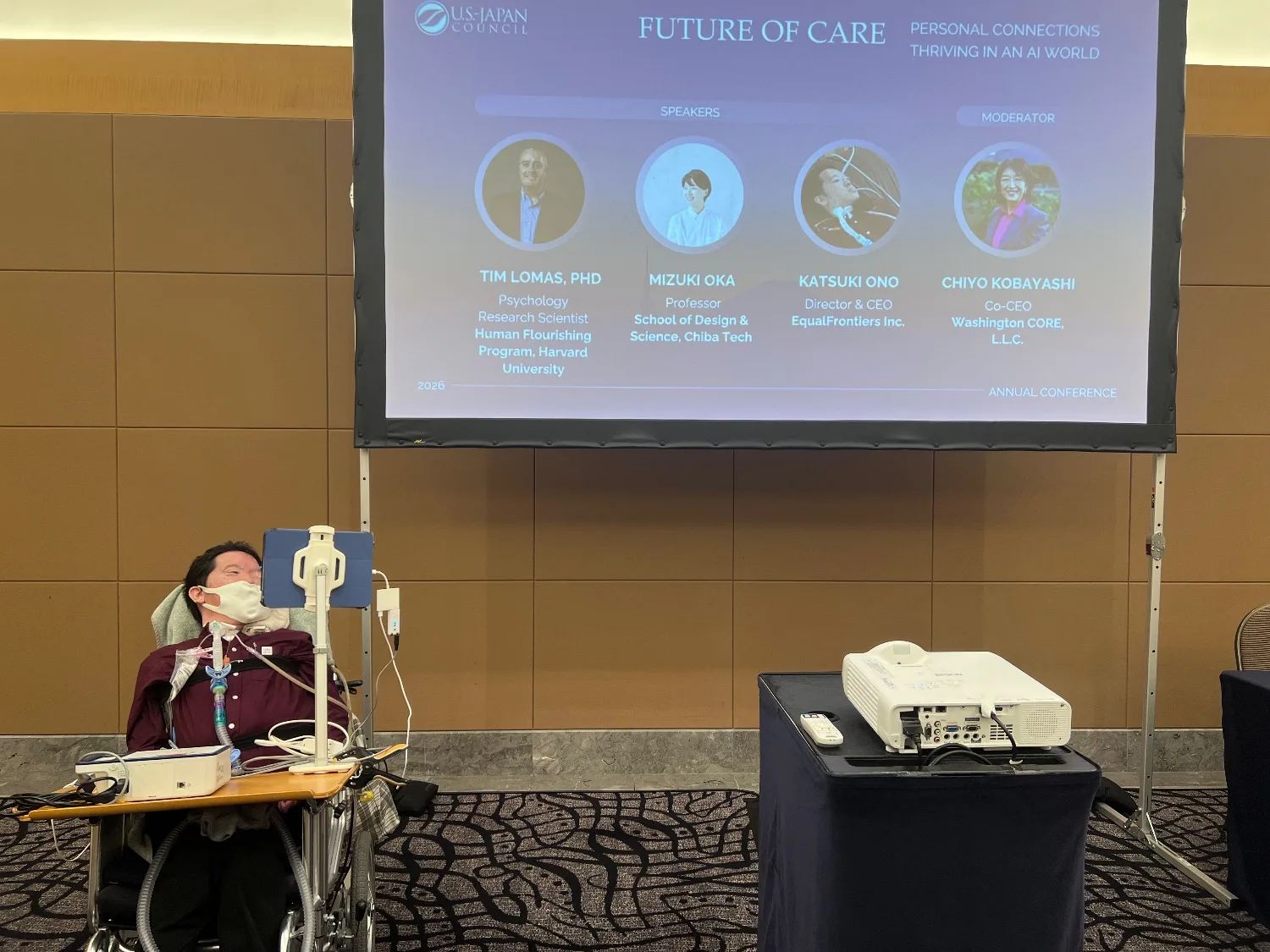
CEO Katsuki Ono Spoke on the “Future of Care” Panel at the U.S.-Japan Council 2026 Annual Conference
On October 15, 2026, the U.S.-Japan Council 2026 Annual Conference was held at the Cerulean Tower Tokyu Hotel in Tokyo. EqualFrontiers CEO Katsuki Ono spoke on the panel “Future of Care: Personal Connections Thriving in an AI World.”
The U.S.-Japan Council works to strengthen ties between the United States and Japan. This year’s conference received congratulatory remarks from Prime Minister Sanae Takaichi, and speakers included Tokyo Governor Yuriko Koike and Member of the House of Representatives Taro Kono.
Panelists
Tim Lomas, PhD (Psychology Research Scientist, Human Flourishing Program, Harvard University)
Mizuki Oka (Professor, School of Design & Science, Chiba Institute of Technology)
Katsuki Ono (Director & CEO, EqualFrontiers Inc.)
Moderator: Chiyo Kobayashi (Co-CEO, Washington CORE, L.L.C.)
“I build AI with one switch”
Ono cannot move below the neck. He operates his computer with a single head-mounted switch, and typing one sentence takes him about a minute and a half.
In his opening presentation, he introduced what he has built through that one switch:
In Google’s Project VOICE, he fine-tuned Gemini on his own messages to build a keyboard that predicts sentences in his own voice (iF Design Award 2026 Gold).
In the University of Tokyo Matsuo Lab’s medical LLM project, he served as a sub-team leader for post-training a large LLM inside a closed environment.
He designed and built the system that runs Helper Station Fair Support, the care office where the helpers who support him work.
He then described the idea of the Reconfiguration of Ability: AI did not give his body back; it changed what ability means. He did not become able to type faster. By articulating intent, judging the output, and directing revisions, he became able to design. This work was accepted as a sole-author paper at ACM ASSETS 2026, the international conference on accessibility.
The discussion
Because he cannot answer in real time, Ono prepared his answers in advance, and the moderator, Ms. Kobayashi, read them aloud. He used this format itself as an example: inclusion should come from redesigning the structure everywhere, not from individual kindness.
Other points he made:
To embrace people with disabilities as technology expands what they can do, three things need to catch up: how we measure ability, real-time norms, and the able-bodied default built into AI itself.
People with disabilities must be not just users of AI, but its evaluators and builders.
AI is an interpreter not only between languages, but between what we know and what we can express. In U.S.-Japan collaboration, too, the most valuable knowledge is what the other side could never have known.
Processes that AI cannot reach, such as paper forms, phone calls, and in-person counters, become new barriers.
His closing message was “Assume capability first.” Care is not doing things for people; it is restoring agency and participation. His helpers do not do his work for him; they make it possible for him to do it. AI does not think for him; it lets his thinking reach the screen. Neither replaces the other.
We are deeply grateful to the U.S.-Japan Council and to our fellow panelists for this opportunity.